Recently, the research group led by Professor Lei Wang from the College of Materials at Shenzhen University has achieved a major research breakthrough in the field of high‑temperature proton exchange membrane fuel cells (HT‑PEMFCs). The relevant findings have been published in Science Advances, a top‑tier international academic journal. The paper is titled “A Membrane‑Guided Strategy for Optimizing Proton Exchange Membrane Fuel Cells via Spatially Controlled Acid Distribution”. Assistant Professor Jingjing Lin is the first author of the paper. Professor Lei Wang and Assistant Professor Jinwu Peng serve as co‑corresponding authors, and Shenzhen University is the primary affiliation of this work.
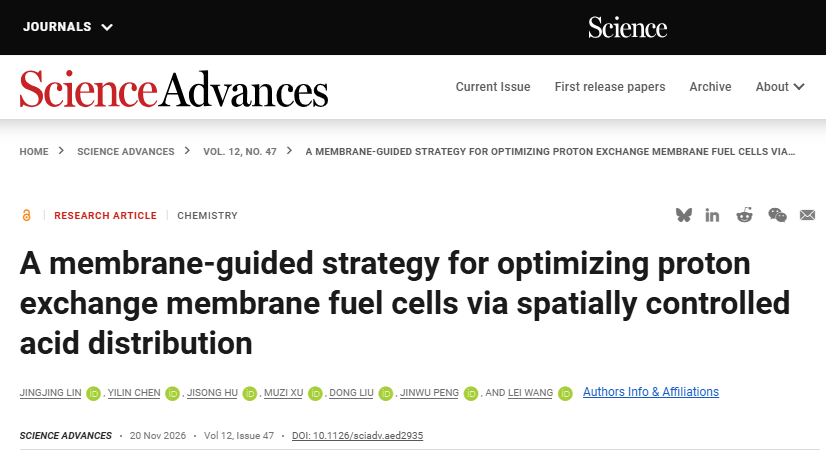
Figure 1 Membrane‑guided strategy for the optimization of proton exchange membrane fuel cells
High‑temperature proton exchange membrane fuel cells represent a promising new‑generation energy‑conversion technology, featuring fast electrochemical kinetics, high carbon monoxide tolerance, as well as simplified thermal and water management systems. The phosphoric‑acid‑doped polybenzimidazole (PA/PBI) membrane system is the mainstream technical route for high‑temperature proton exchange membranes. Nevertheless, a core contradiction has long plagued this research field: membrane‑oriented studies tend to suppress phosphoric acid diffusion into the catalyst layer to preserve the intrinsic membrane conductivity, whereas catalyst‑layer‑related research requires higher local acid content to boost proton transport. This mismatch hinders the overall performance improvement of membrane electrode assemblies (MEAs). Excessive phosphoric‑acid migration causes pore flooding within the catalyst layer and impedes oxygen mass transport; insufficient acid content damages the three‑phase reaction interface and impairs proton conduction capacity. Precisely regulating acid distribution inside membrane electrode assemblies to strike a synergistic balance between proton conduction and oxygen transport constitutes a critical bottleneck for performance upgrading of high‑temperature fuel cells.
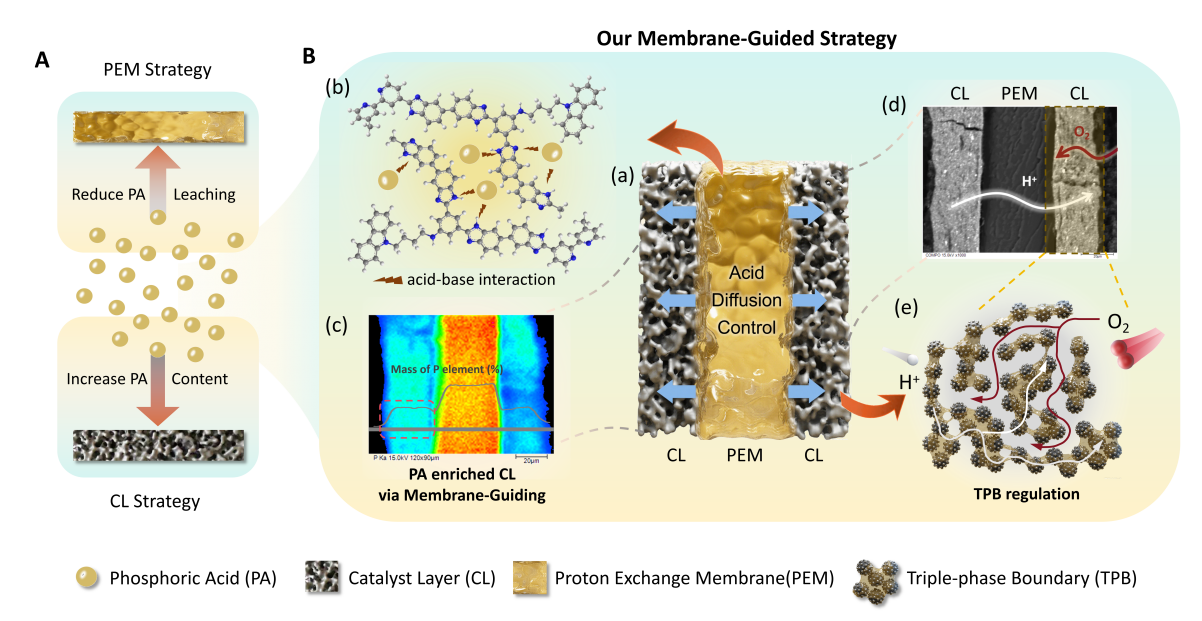
Figure 2 Schematic illustration of the membrane‑guided acid‑distribution regulation strategy for synergistically optimizing proton conduction and oxygen transport in high‑temperature proton exchange membrane fuel cells
To address this challenge, the authors propose a novel membrane‑guided acid‑distribution regulation strategy. By designing side‑chain‑grafted polybenzimidazole membrane materials with abundant acid‑binding sites, the strategy achieves high acid‑doping levels and precisely modulates the redistribution behavior of phosphoric acid toward the catalyst layer. The carbazole side‑chain‑modified BC membrane developed by the research team delivers high acid‑adsorption capacity and outstanding mechanical stability, with a maximum acid‑doping level up to 600%, which is considerably superior to conventional OPBI membranes. For the first time, this study introduces the PACL/PtCL mass ratio as a semi‑quantitative descriptor for catalyst‑layer acid content. Combined with the distribution of relaxation times (DRT) analysis, the research systematically decouples the distinct influences of catalyst‑layer acid content on oxygen‑reduction‑reaction kinetics, proton‑transport resistance and oxygen mass‑transport resistance. Results reveal that an optimal balance between proton conduction and oxygen transport can be attained when the PACL/PtCL mass ratio falls within the range of 2‑3 for the current membrane‑electrode system. Fuel cells assembled with BC membranes at the optimal doping level deliver a peak power density of 969 mW·cm-2. Under galvanostatic operation at 160 °C and 0.2 A·cm-2 over 100 hours, the voltage degradation rate is merely 2.42 μV·h-1, demonstrating remarkable power output and long‑term operational stability.
This research breaks the conventional paradigm of separate optimization for proton exchange membranes and catalyst layers. It establishes rational design principles for membrane‑guided acid redistribution and identifies the optimal acid‑content window for catalyst layers. The work offers brand‑new research perspectives and theoretical guidance for developing polymer electrolytes, realizing membrane‑electrode interface integration and boosting the performance of next‑generation high‑temperature fuel cells.
This work was supported by the National Natural Science Foundation of China, grants from the Shenzhen Science and Technology Innovation Commission, and Shenzhen Science and Technology Program.
Link: https://doi.org/10.1126/sciadv.aed2935
Editor:Jingjing Lin
Reviewers:Rongying Wang, Dong Wang, Lei Wang