Recently, Associate Professor Sui Xulei from the College of Materials Science and Engineering of Shenzhen University, together with Professor Wang Zhenbo from Harbin Institute of Technology and their research team, have made a series of research advances in the fields of energy catalysis and sodium-ion storage focusing on the Janus effect of Fe–Co dual atom sites. The team published a research paper titled “Janus effect of FeCo dual atom catalyst with Co as active centre in acidic oxygen reduction reaction” in Nat. Commun. The co-first authors are Yuan Longji, a graduate of Shenzhen University, Associate Professor Sui Xulei, and Miao Zhenyu from Harbin Institute of Technology. The corresponding authors of the paper are Associate Professor Sui Xulei from Shenzhen University, Associate Professor Wang Xiaozu from Tamkang University, Associate Professor Zhang Guoxu and Professor Wang Zhenbo from Harbin Institute of Technology.At the same time, a research paper titled “FeCoN6 Sites Unlock Superior Sodium-Ion Storage Through Synergizing Capture-Release and Orbital-Mediated Charge Delocalization” was published in Angewandte Chemie International Edition. Associate Researcher Feng Wenliang and Postdoc Xu Huifang from Shenzhen University are co-first authors, while Associate Professor Sui Xulei from Shenzhen University and Professor Wang Zhenbo from Harbin Institute of Technology are the corresponding authors. Shenzhen University is the primary corresponding institution.
In energy conversion and storage devices, many critical reactions occur at tiny active sites on the material’s surface. Traditional single-atom catalysts can maximise the utilisation of metal atoms, but a single metal centre often has to handle multiple tasks like adsorption, activation, transfer, and release at the same time, which can lead to problems of being either too tight or too loose: too tight hinders intermediate desorption or ion migration, while too loose makes it hard to effectively activate reactants. This contradiction has long limited the kinetic performance of fuel cell cathode oxygen reduction reactions and sodium-ion storage anodes. Dual-atom catalysts offer a new way to tackle this. Unlike single-atom sites, the two adjacent metal atoms in dual-atom sites not only maintain high atomic-level efficiency but also enable different functional roles through electronic coupling. Similar to Janus in ancient Roman mythology with his two-faced image, one side of a heteronuclear dual-atom site can capture or stabilise key intermediates, while the other is responsible for rapid catalytic conversion or ion release, achieving “division of labour and collaboration” within a single atomic-level structure.
The results focus on the acidic oxygen reduction reaction at the fuel cell cathode. The oxygen reduction reaction is a key step in fuel cell power generation, and its reaction rate directly affects the output power of the fuel cell. The team constructed a bimetallic Fe–Co dual-atom catalyst with strong Fe–Co bonding using molecular chelation and ion-coupling strategies (Figure 1). In situ X-ray absorption spectroscopy, in situ infrared spectroscopy, and theoretical calculations together indicate that at the Fe–Co dual-atom sites, Fe and Co are not simply “added together”; instead, they form a clear Janus-like division of labour: the Fe atoms preferentially stabilise adsorbed OH intermediates, thereby tuning the electronic structure of neighbouring Co atoms, while the Co atoms act as the main catalytic centres, carrying out the four-electron oxygen reduction continuously. Through this cooperative division of labour, the rate-determining step shifts from difficult OH desorption to *OOH formation, reducing the theoretical overpotential from 1.14 V to 0.43 V. This catalyst achieves a half-wave potential of 0.852 V under acidic conditions, reaches a power density of 1.14 W cm-2 in H2–O2 fuel cells, and retains 81% of its peak power after 10,000 cycles, showing excellent activity and durability.
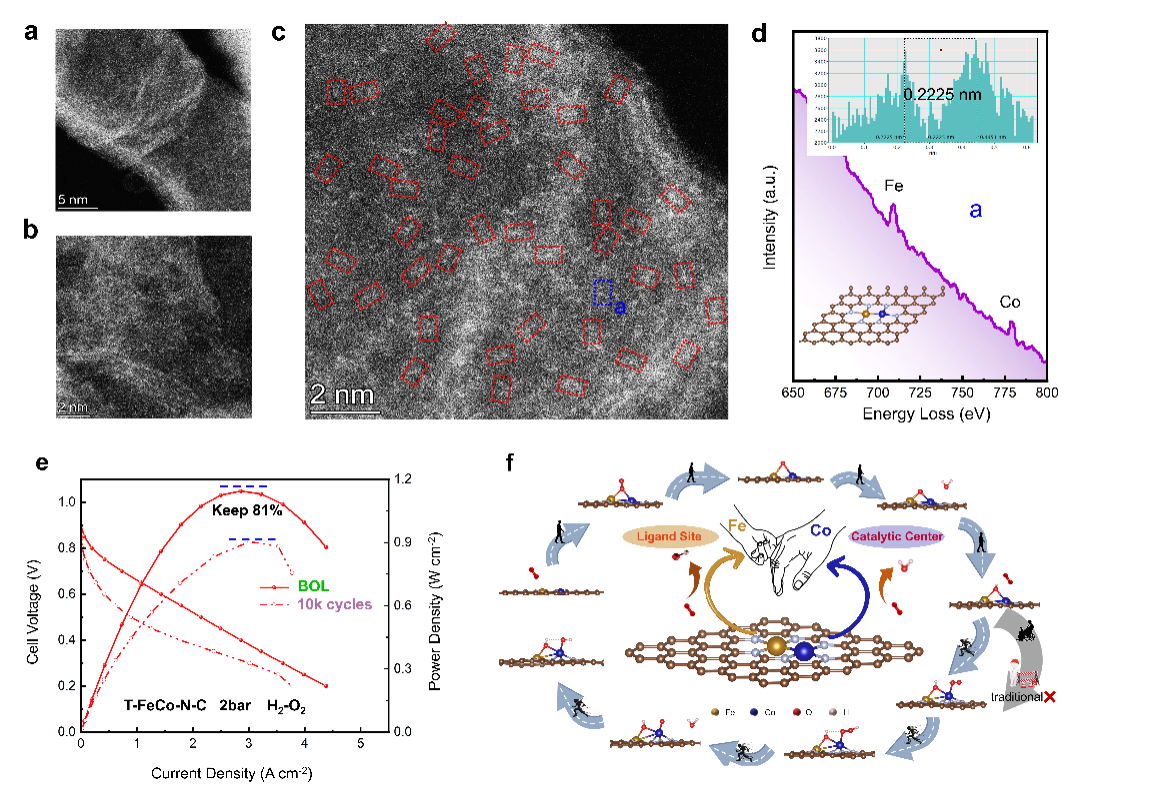
Figure 1 a-c, spherical aberration-high-angle annular dark field scanning transmission electron microscopy images; d, electron energy loss spectrum of the blue-marked area in c; e, power density electrode voltage polarization curves of the catalyst fuel cell hydrogen-oxygen membrane electrode before and after accelerated aging test; f, schematic diagram showing how the Janus effect of Fe–Co dual-atom sites promotes the acidic oxygen reduction reaction
The second achievement further extends the Fe–Co dual-atom Janus division concept to the field of sodium-ion storage. Sodium ions are abundant and low-cost, and sodium-ion hybrid capacitors combine the high energy density of batteries with the high power characteristics of supercapacitors, but their anodes often face bottlenecks such as slow sodium-ion diffusion and sluggish interfacial charge transfer. The research team designed FeCoN6 dual-atom sites, allowing Fe and Co to form a “capture-release” cooperative pathway at the atomic level. Fe sites provide strong Na capture capability, while Co sites offer relatively weaker migration/release channels. Meanwhile, strong d–d orbital coupling between Fe and Co induces orbital-mediated charge delocalisation, lowering the overall d-band centre, reducing Na+ binding strength and diffusion barriers. Theoretical calculations show that the Na+ migration barrier for FeCoN6 sites is 0.42 eV, lower than 0.57 eV for FeN4 and 0.53 eV for CoN4. Thanks to this dual cooperative mechanism, the FeCo–N–C anode exhibits pseudocapacitance-dominated rapid sodium-ion storage, maintaining a high-rate capacity of 225 mAh g-1 at 10 A g-1. The assembled FeCo–N–C||AC sodium-ion hybrid capacitor achieves a high energy density of 165 Wh kg-1, retains 108 Wh kg-1 even at a high power density of 9424 W kg-1, and maintains 90% capacity after 10,000 cycles, showing good application potential.
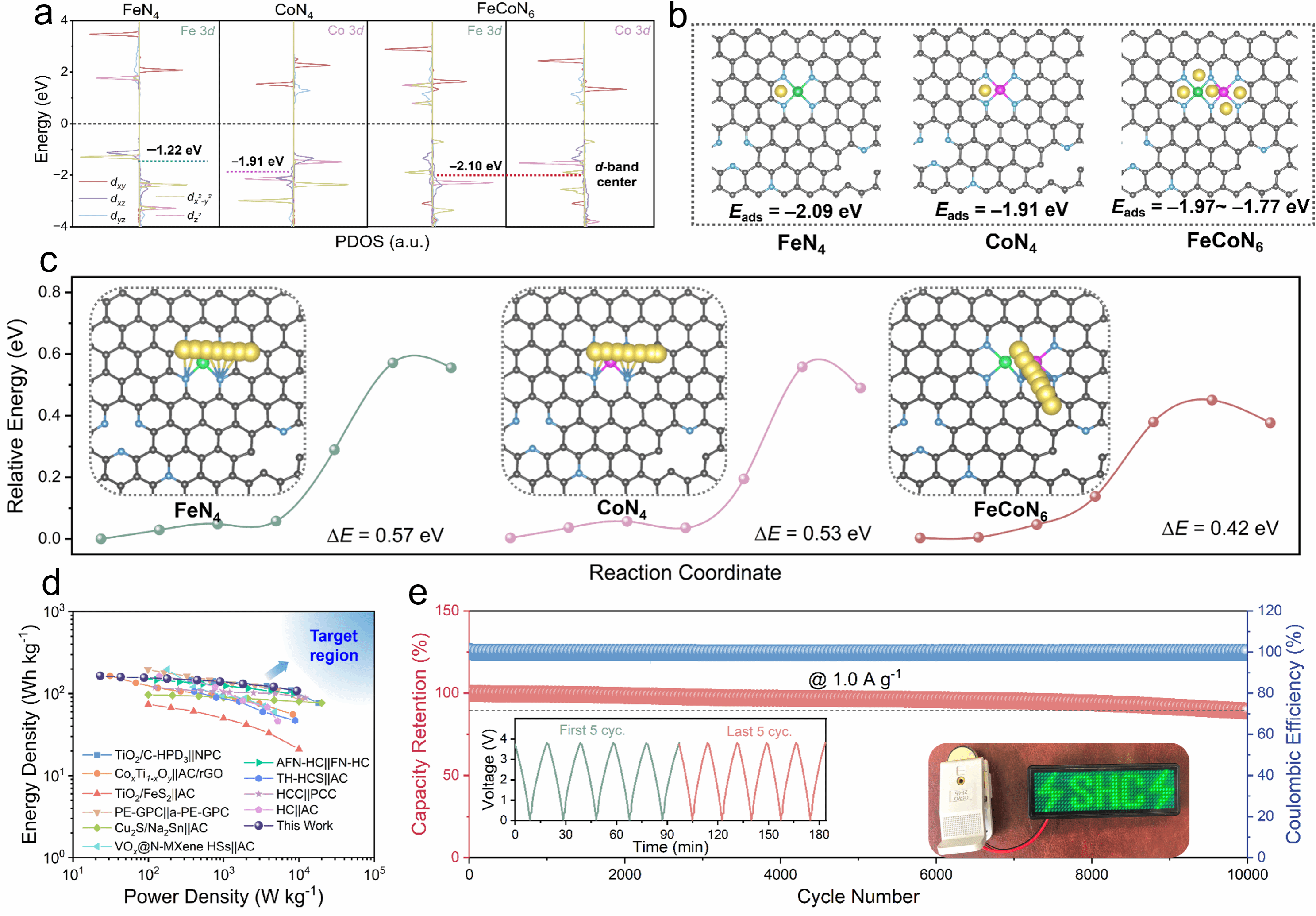
Figure 2 a, Schematic of orbital regulation of FeCoN6 dual-atom sites and comparison of d-band centres; b, Comparison of Na+ adsorption behaviour and adsorption energy at different sites; c, Comparison of Na migration paths and diffusion barriers at different atomic sites; d, Comparison of energy density and power density of sodium-ion hybrid capacitors; e, Long-term cycling stability of sodium-ion hybrid capacitors
Two studies looking at different energy scenarios tackled the same core question: how can atomic-level active sites both “grab” and “let go” quickly. In acidic oxygen reduction reactions, Fe–Co dual-atom sites get around the usual problem of single active centres struggling to balance sticking and releasing intermediates, thanks to a kind of Janus setup where “Fe stabilises *OH and Co handles the main reaction”. In sodium-ion storage, FeCoN6 sites make low-barrier pathways for Na+ with “Fe captures, Co releases” and charge delocalisation control. The two findings link up, showing the Janus effect of Fe–Co dual-atom sites isn’t just for catalysis but also works for ion storage, giving a fresh atomic-level approach for designing efficient fuel cell catalysts and high-power sodium-ion storage materials.
Project support:
The related work was funded by the National Natural Science Foundation of China, the Shenzhen High-Level Team Project, the Shenzhen Science and Technology Plan Project, the Guangdong Basic and Applied Basic Research Fund, the Shandong Key R&D Program, the Heilongjiang Leading Team Project, and the basic research funds of central universities
Paper link:
https://doi.org/10.1038/s41467-025-62728-4
https://doi.org/10.1002/anie.202525480