Recently, Associate Professor Sui Xulei from the College of Materials Science and Engineering of Shenzhen University, together with Professor Wang Zhenbo from Harbin Institute of Technology and other research teams, have made a series of research advances in the interface structure regulation of single-atom catalysts for the acidic oxygen reduction reaction in fuel cell cathodes. The team published a research paper titled “Stabilizing High-Activity FeN5 Sites via an Adaptive N-linked Carbon Bilayer for Stable Fuel Cells” in Angew. Chem. Int. Ed., with Shenzhen University graduates Yuan Longji and Li Qi and Harbin Institute of Technology's Miao Zhenyu as co-first authors, while Associate Professor Sui Xulei from Shenzhen University and Professor Wang Zhenbo from Harbin Institute of Technology are the corresponding authors.At the same time, a research paper titled “Breaking the Intermediate Solvation Shell on Single-Atom Catalysts With a Proximal Group Perturber for Enhanced Oxygen Reduction” was published in Adv. Mater. The co-first authors are Han Chaoyang, a joint master's student from Shenzhen University and Yanshan University, Gan Ruihui from the Chinese Academy of Sciences, and Gong Tao, a master's student from Shenzhen University. The corresponding authors are Associate Professors Sui Xulei and Zheng Yongping from Shenzhen University, Professor Shao Guangjie from Yanshan University, and Professor Wang Zhenbo from Harbin Institute of Technology. Shenzhen University is the primary corresponding institution.
Single-atom catalysts have huge potential in electrocatalysis, especially in fuel cell oxygen reduction, and could even replace expensive platinum-based catalysts. However, due to their unique structures, the number and stability of active sites in single-atom catalysts still struggle to meet device requirements, so a lot of current research focuses on tuning the active site structures. By building the structure of these sites, we can not only optimise the coordination structure and enhance how electronic effects control reaction pathways but also improve the interface microenvironment, manage the hydrogen bond network at the interface, and speed up the reaction process.
The outcome proposes a “repair-upgrade” engineering strategy, which synchronously supplements carbon and nitrogen through in situ chemical vapour deposition, not only repairing defects generated by pyrolysis but also upgrading the traditional FeN4 configuration to a stable five-coordinated FeN5 site, while simultaneously constructing a nitrogen-linked carbon bilayer in situ. Axial nitrogen coordination regulates the electronic structure of the Fe centre to enhance intrinsic activity, and the adaptive interlayer spacing of the carbon bilayer compensates for fluctuations in the axial Fe-N bond length during catalysis, thus anchoring the active sites. The resulting catalyst achieves a peak power density of up to 1.221 W cm-2 in H2-O2 fuel cells and retains more than 85% of its power density after 10,000 cycles; in H2-air tests, it runs at 0.6 V for 45 hours with almost no decay. This design provides a new way to stabilise single-atom catalysts.
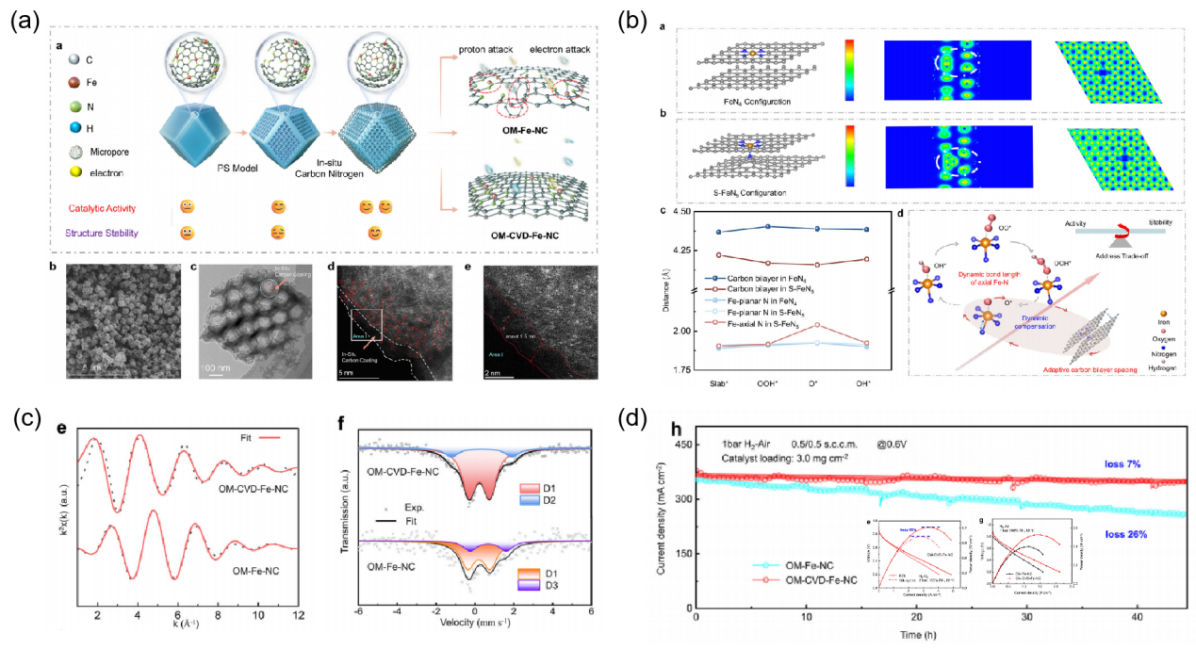
Figure 1 a, catalyst process; b, adaptive carbon bilayer stabilization mechanism; c, XANES and EXAFS fitting and ⁵⁷Fe Mössbauer spectra; d, proton exchange membrane fuel cell polarization curve and stability chart.
Result two proposes a universal strategy for stabilising single-atom catalysts using molecular perturbations, shifting the control of the hydrogen bond network from the electrolyte to the catalyst's secondary coordination layer. Using iron-nitrogen-carbon single-atom catalysts in the oxygen reduction reaction as a model, it was confirmed that neighbouring phospho-oxygen (P-O) groups can act as steric hindrance and hydrogen bond-type dual-function perturbation groups. Spectral characterisation and theoretical calculations indicate that this artificially designed microenvironment selectively weakens the solvation shell of key hydroxyl intermediates (*OH), thus promoting the rate-limiting step of OH desorption. This control strategy endows the catalyst with excellent electrocatalytic performance: in a sulphuric acid electrolyte, the oxygen reduction reaction half-wave potential reaches 0.861V; in a hydrogen-oxygen proton exchange membrane fuel cell, the peak power density of the cell reaches 1024 mW・cm-2. Additionally, the catalyst shows outstanding stability, maintaining 72% of its current after continuously operating at 0.65 V for 253 hours. This study represents a shift in the research approach for electrocatalysts from optimising a single active site to precise engineering of the local microenvironment, providing a new route for achieving efficient electrocatalysis under real device conditions.
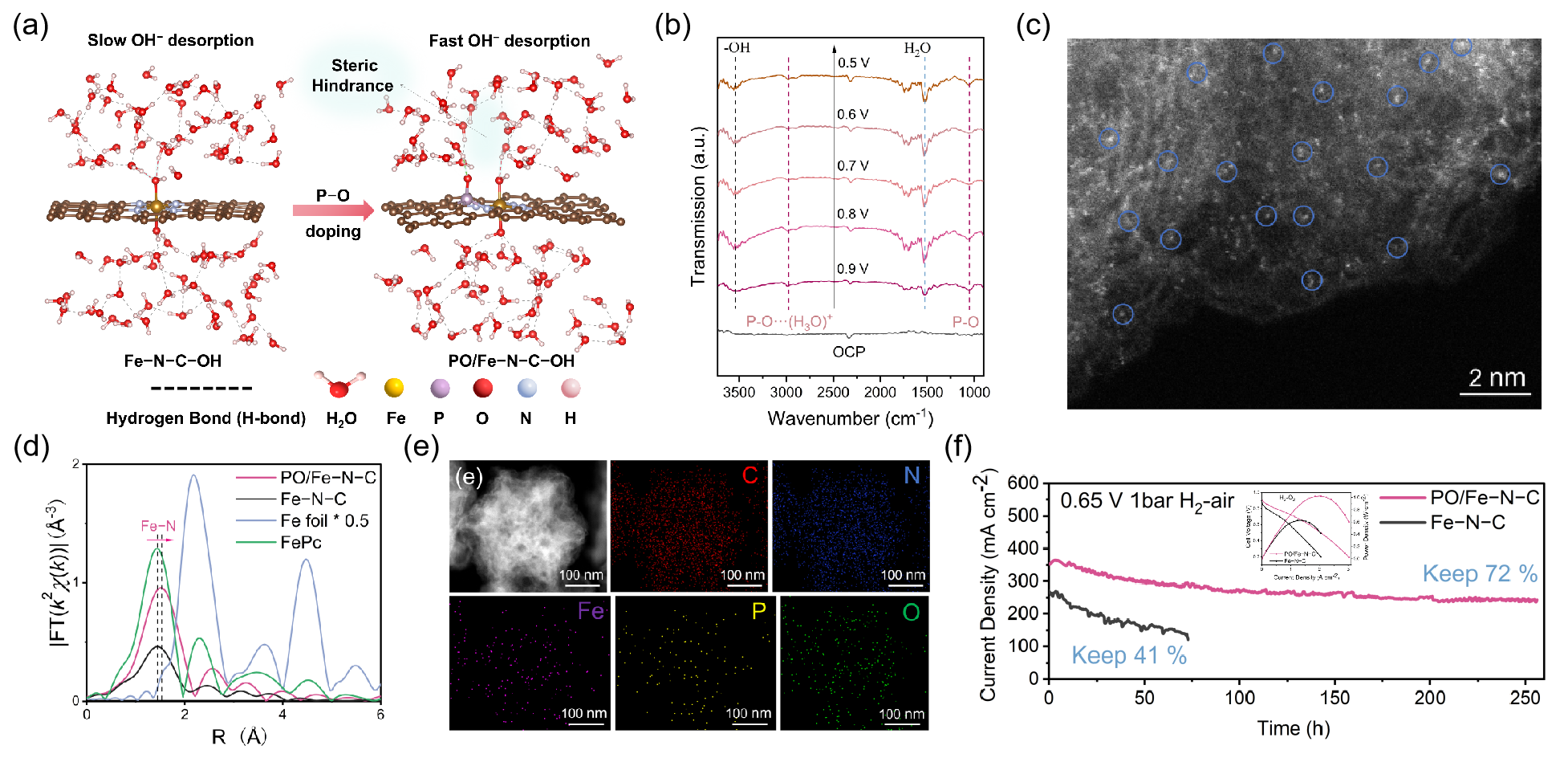
Figure 2 a, interface structure from ab initio molecular dynamics (AIMD) simulation; b in situ infrared test; c, aberration-corrected elemental distribution map with single atom snapshots of the corresponding area; d, XAS fine spectrum R-space structure map; f, polarization curve and stability diagram of the proton exchange membrane fuel cell.
Both studies focused on common challenges faced by traditional single-atom catalysts, such as limited activity, prominent intermediate solvation effects, and the difficulty of balancing activity and stability. They carried out in-depth regulation at the levels of coordination microenvironment, local interface, and electronic structure, and combined theoretical calculations with device tests to verify mechanisms and performance, effectively solving the key issue of balancing high activity and long-term stability in single-atom catalysts, and providing a new approach for designing high-performance cathode materials for fuel cells.
Project support:
The relevant work was funded by the National Natural Science Foundation of China, Shenzhen High-Level Team Project, Shenzhen Science and Technology Plan Project, Guangdong Basic and Applied Basic Research Fund, Shandong Key R&D Program, Heilongjiang Leading Team Project, and the Basic Research Funds for Central Universities.
Paper link:
https://doi.org/10.1002/anie.6494121
https://doi.org/10.1002/adma.202523627