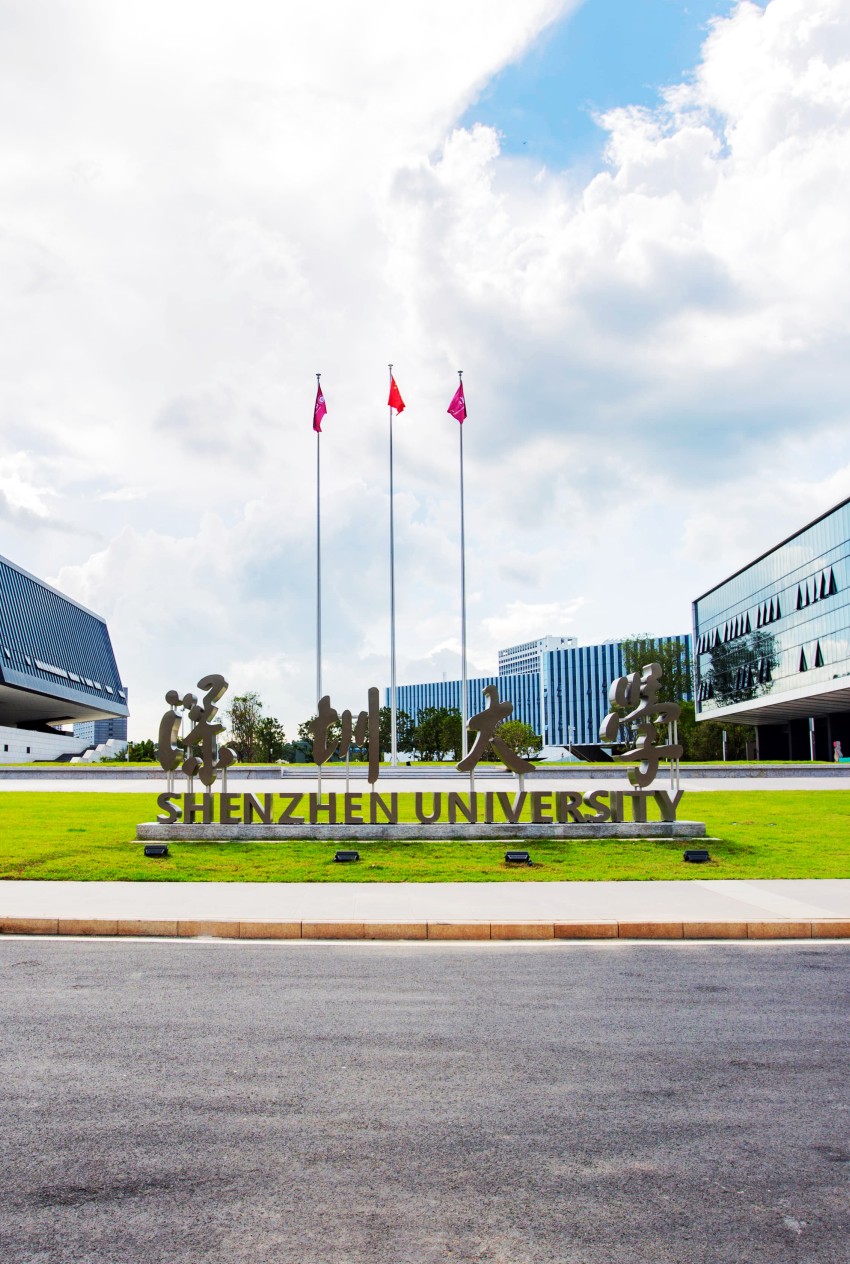
In early 2026, research teams from the College of Materials Science and Engineering of Shenzhen University have achieved a succession of exciting research breakthroughs. A number of high-quality research papers have been successively published in multiple Nature portfolio journals, including Nature Protocols, Nature Reviews Chemistry and Nature Communications. These achievements fully demonstrate the college’s strong research strength and vibrant innovation capacity in the field of materials science.
In January 2026, Professor Yang Chuluo and Assistant Professor Chen Zhanxiang from the College of Materials Science and Engineering published a research paper entitled “Deuteration promotes circularly polarized light emission by suppression of vibration” in the internationally renowned journal Nature Communications. Assistant Professor Chen Zhanxiang from the College of Materials Science and Engineering was the sole first author of this study, Professor Yang Chuluo from College of Materials Science and Engineering of Shenzhen University was the sole corresponding author, and Shenzhen University was the only affiliated institution.
By deuterating CPL materials, the luminescence quantum yield and the dissymmetry factor can be synergistically enhanced. The key to this strategy is that deuteration effectively suppresses molecular backbone vibrations, which both weakens exciton-vibration coupling and reduces energy loss through non-radiative decay, thereby increasing the luminescence quantum yield, and mitigates conformation disorder caused by vibrations, reducing their negative impact on circularly polarised luminescence dissymmetry factors, hence improving the dissymmetry factor. Experimental results show that the photoluminescence quantum yield of deuterated CPL molecules in non-doped films reaches up to 90%, and their photoluminescence dissymmetry factor is more than twice that of the comparison molecules. Corresponding circularly polarised organic light-emitting diodes(CP-LODE) also perform exceptionally well, with deuterated CPL molecules achieving a maximum external quantum efficiency of nearly 40% as both emitter and host materials; the electroluminescence dissymmetry factor can reach up to 6.4 × 10⁻³. Moreover, this strategy is versatile and has been verified in another chiral molecular system, further boosting the electroluminescence dissymmetry factor of the corresponding CP-OLED to 1.0 × 10⁻². These results provide new insights for the design of high-performance CPL materials and demonstrate their broad potential for future applications.
Paper link:https://www.nature.com/articles/s41467-025-67342-y.
In March 2026, Professor Chen Xiaoqiang and Professor Li Mingle from the College of Materials Science and Engineering of Shenzhen University, together with Fellow Tony D. James from the University of Bath, published a review paper titled “Enhancing the targeting ability of metal-organic frameworks in cancer therapy and diagnosis” in the internationally renowned journal Nature Reviews Chemistry. Tong Peihong is the sole first author of the paper, with Professors Li Mingle, Chen Xiaoqiang and Fellow Tony D. James as co-corresponding authors, and Shenzhen University as the primary institution for the paper.
This review aims to give readers a concise guide to help design bio-enabled MOF for specific biological applications. It first classifies the strategies for giving MOF targeted functions, including non-covalent interactions, covalent interactions, and coordination interaction strategies. Then, it discusses the applications of MOF modified with antibodies, peptides, aptamers, carbohydrates, cell membranes, and other targeting strategies. Finally, it outlines future challenges and prospects for building MOF with targeting functions, offering guidance for developing the next generation of MOFs for precise cancer diagnosis and treatment, and speeding up their clinical application of MOF.
The key takeaway from this review is that targeting MOF isn’t just about attaching a recognition molecule on the surface; it’s about optimising the MOF structure, linkage chemistry, targeting molecules, biological interface and clinical context as a whole. In the future, MOF can truly move from being just a pretty nanoplatform to practical precision cancer diagnosis and treatment only if real progress is made in targeting ligand stability, in vivo integrity, material toxicity, batch consistency, scalable production and clinical model validation.
Paper link:https://doi.org/10.1038/s41570-024-00807-w.
In March 2026, Professor Chen Xiaoqiang and Professor Li Mingle's team from the College of Materials Science and Engineering of Shenzhen University published a paper titled “Preparation of ENBSe-based photoredox catalysts for O2-independent phototherapy in living systems” in Nature Protocols. This continues the work they previously published in the Journal of the American Chemical Society.
This paper addresses the limitations of traditional photodynamic therapy, which relies on oxygen and is restricted by the hypoxic tumour microenvironment, by developing ENBSe, a selenium-substituted Nile blue derivative as a metal-free, near-infrared responsive photocatalyst that does not depend on oxygen. It also establishes the tumour hypoxia-responsive conditionally activated photocatalytic system ENBSe–NTR and provides standardised experimental procedures for synthesis, characterisation, and in vivo and in vitro applications. The main steps include: (1) synthesis of the photocatalyst ENBSe; (2) evaluation of its photocatalytic performance; (3) construction of the conditionally activated photocatalytic (ConAPC) system; (4) establishment of hypoxic cell models; (5) comprehensive verification of ENBSe’s photocatalytic therapy capabilities in vitro and in vivo. This study overcomes the oxygen dependency bottleneck of traditional phototherapy and offers a new strategy for targeted phototherapy in hypoxic tumours. Its standardised experimental procedures also provide valuable references for the development and application of new photocatalysts, promoting progress in the field of photocatalytic diagnosis and treatment. Postdoctoral researcher Zhang Yingying is the sole first author, Professor Li Mingle is the sole corresponding author, and Shenzhen University is the first author and corresponding author institution.
Paper link:https://www.nature.com/articles/s41596-025-01328-4.
In April 2026, the research team led by Professor Huang Yanfei from the College of Materials Science and Engineering collaborated with the group of Professor He Yanbing at Tsinghua Shenzhen International Graduate School to publish a research paper titled “Suppressing concentration polarization in lithium battery composite polymer electrolytes via piezo-assisted electromechanical coupling effect” in Nature-indexed journal Nature Communications. Dr. Yin Jiayi, a postdoctoral researcher at the College of Materials Science and Engineering of Shenzhen University, is the sole first author of this work. Professor He Yanbing and Professor Huang Yanfei serve as the corresponding authors, and Shenzhen University is designated as the primary affiliation of the paper.
In this study, a piezoelectric polymer composite electrolyte blended with polyvinylidene fluoride (PVDF) and 0.5Ba(Zr0.2Ti0.8)O3-0.5(Ba0.7Ca0.3)TiO3(BCTZ) was fabricated. Taking advantage of volume fluctuation of lithium metal anode during cycling, the electrolyte generates a gradient piezoelectric field that selectively accelerates Li⁺ transport while hindering the migration of anions, thereby fundamentally suppressing concentration polarization (Figure 1). Benefiting from this design, the as-prepared electrolyte exhibits remarkably mitigated concentration polarization and delivers an ultrahigh critical current density of 3.7 mA cm⁻². Stable Li plating/stripping can be maintained even under a high current density of 2 mA cm⁻². Moreover, the assembled Li||Ni0.8Co0.1Mn0.1O2 full cell achieves outstanding cycling stability for over 2600 cycles within a wide voltage window of 2.8–4.5 V. This work proposes a novel mechano-electrochemical conversion strategy. By constructing piezoelectric electrolytes, the unavoidable volume variation of lithium metal is actively utilized to minimize Li⁺ concentration gradients. It offers an effective avenue toward high-performance lithium metal batteries.
Original link: https://www.nature.com/articles/s41467-026-72527-0.
Proofread by: Zhang Xiaoying, Wang Dong, Wang Lei