On 16 March 2026, Professor Chen Xiaoqiang and Professor Li Mingle's team from the College of Materials Science and Engineering of Shenzhen University, together with Fellow Tony D. James from the University of Bath, published a review paper titled “Enhancing the targeting ability of metal-organic frameworks in cancer therapy and diagnosis” in the internationally renowned journal Nature Reviews Chemistry. Tong Peihong is the sole first author of the paper, and Professor Li Mingle, Professor Chen Xiaoqiang, and Fellow Tony D. James are the joint corresponding authors, with Shenzhen University being the primary institution for the paper.
In the field of cancer diagnosis and treatment, 'precise diagnosis' and 'targeted therapy' have always been the main goals researchers chase. Metal-organic frameworks(MOFs), these hybrid organic-inorganic porous materials with both structural diversity and multifunctionality, have become a key bridge connecting materials science and precise cancer diagnosis and treatment due to their tunable metal nodes and organic ligands. Since 2010, MOFs with targeting capabilities have gradually entered the biomedical scene, evolving from passive targeting relying on the EPR effect to active targeting with precise molecular modifications, continually upgrading their use in cancer diagnosis and treatment.
This review aims to give readers a concise guide to help design bio-enabled MOFs for specific biological applications. It first classifies the strategies for giving MOFs targeted functions, including non-covalent interactions, covalent interactions, and coordination interaction strategies. Then, it discusses the applications of MOFs modified with antibodies, peptides, aptamers, carbohydrates, cell membranes, and other targeting strategies. Finally, it outlines the future challenges and prospects for creating MOF with targeting functions, To provide guidance for the development of next-generation MOFs capable of enabling precision cancer diagnosis and treatment, and to accelerate the advancement of MOFs in clinical applications.
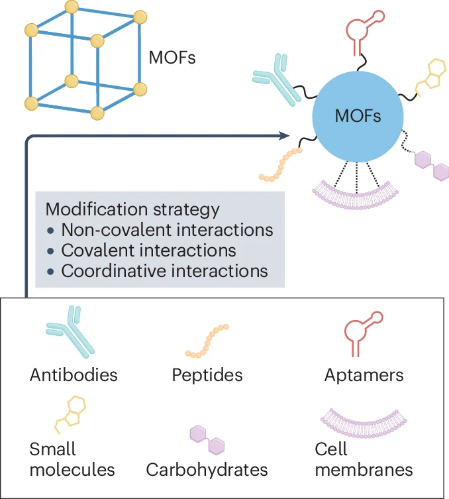
Figure 1. Design concept of bio-enabled metal-organic frameworks. To enhance the targeting ability of metal-organic frameworks (MOF), a common strategy is to attach targeting groups to their surfaces, giving them biological recognition capabilities. These targeting groups include antibodies, peptides, aptamers, small molecules, carbohydrates, and cell membranes, which effectively conjugate with MOFs through non-covalent interactions, covalent interactions, and coordination interactions, creating bio-nano conjugates that can be used for precise cancer diagnosis and targeted therapy.
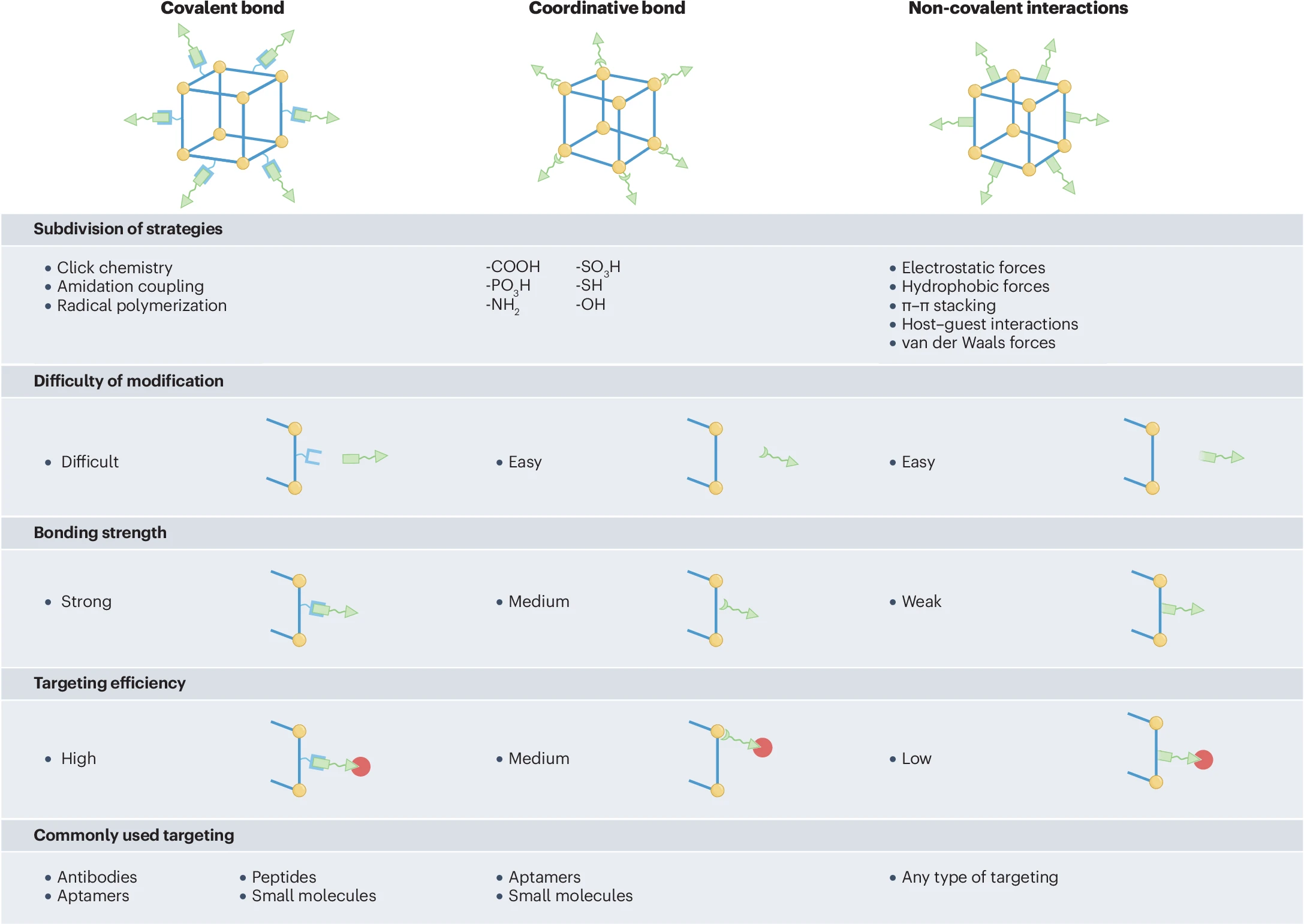
Figure 2. Surface functionalisation strategies for metal-organic frameworks. A schematic of modifying the exterior surface of metal-organic frameworks using covalent bonds (left), coordination bonds (middle) and non-covalent interactions (right), along with a comparison of the features of different modification strategies. The blue framework represents the metal-organic framework structure, the green parts represent the attached targeting groups, and the red parts represent the targeting receptors.
The most important insight from this review is that the essence of MOF-targeted therapy lies not merely in 'attaching a recognition molecule to the surface,' but in achieving holistic optimization among the MOF structure, linking chemistry, targeting molecules, biological interfaces, and clinical settings. In the future, MOFs will only truly transition from an impressive nanotechnology platform to precise cancer diagnosis and treatment applications if substantial progress is made in the stability of targeting ligands, in vivo integrity, material toxicity, batch consistency, large-scale preparation, and validation using clinically relevant models.
The author thanks the China National Natural Science Foundation, the third phase project of Shenzhen University's high-level university construction, Shenzhen University's research team training program, Guangdong Province's key regional projects for general universities, Shenzhen University 2035 Excellent Research Program, Shenzhen Science and Technology Plan, Guangdong Province's Basic and Applied Basic Research Fund, China Postdoctoral Science Foundation, and other special funding for support.
Original link: https://doi.org/10.1038/s41570-024-00807-w.
Proofread by: Zhang Xiaoying, Wang Dong, Wang Lei