On December 18, 2025, Professor Yang Chuluo and Assistant Professor Chen Zhanxiang from Shenzhen University published a research article titled “Deuteration promotes circularly polarized light emission by suppression of vibration” in the internationally renowned multidisciplinary journal Nature Communications. Paper link: https://www.nature.com/articles/s41467-025-67342-y.
Circularly polarized light (CPL) holds broad application potential in fields such as spin-based optical communication, quantum computing, and display technologies. However, its development has long been limited by a key technical bottleneck: an inherent trade-off between the quantum yield and the dissymmetry factor of luminescent materials. From a mechanistic perspective, the photoluminescence quantum yield of a CPL emitter is positively correlated with the electric transition dipole moment, whereas the dissymmetry factor is negatively correlated with it. This makes it extremely challenging to simultaneously improve both key performance metrics within the same CPL emitter. To address this critical scientific issue, Professor Yang Chuluo’s team has conducted a series of studies over the past three years (Adv. Mater. 2022, 34, 2109147 ; Adv. Funct. Mater. 2023, 33, 2215179; Chem. Sci. 2023, 14, 6022-6031). During their research, the team discovered that conformational disorder induced by molecular vibrations significantly weakens CPL performance, thereby becoming one of the key factors limiting further improvement of CPL materials.
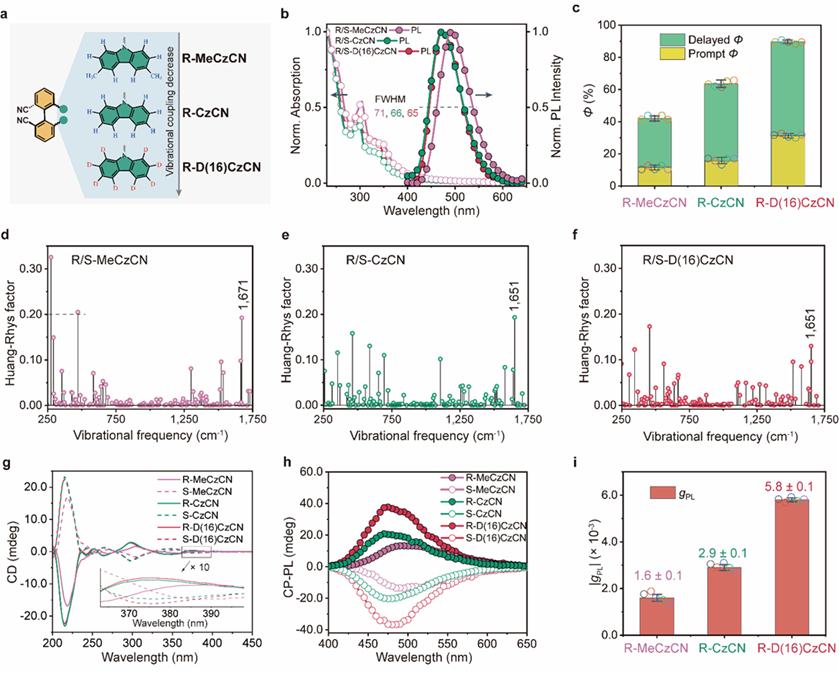
Based on this finding, Professor Yang Chuluo’s team at Shenzhen University proposed a deuteration strategy for CPL materials to achieve simultaneous enhancement of both the photoluminescence quantum yield and the dissymmetry factor. The key to this strategy is that deuteration effectively suppresses molecular skeletal vibrations. On the one hand, it reduces exciton-vibration coupling, thereby decreasing non-radiative energy loss and increasing the quantum yield. On the other hand, it alleviates vibration-induced conformational disorder, mitigating its negative impact on the circularly polarized luminescence dissymmetry factor and thus enhancing the dissymmetry factor. Experimental results show that the deuterated CPL molecules achieve a photoluminescence quantum yield as high as 90% in neat films, and their photoluminescence dissymmetry factor is increased by more than twofold compared with that of the control molecules. Circularly polarized organic light-emitting diodes (CP-OLEDs) incorporating the deuterated CPL molecules as either emitters or host exhibit high performance, achieving a maximum external quantum efficiency close to 40% and an electroluminescence dissymmetry factor of 6.4 × 10⁻³. Furthermore, this strategy is general and has been validated in another chiral molecular system, where the electroluminescence dissymmetry factor of the corresponding CP-OLEDs is further enhanced to 1.0 × 10⁻². These results provide new insights into the design of high-performance CPL materials and demonstrate their broad prospects for future applications.
Nature Communications currently has an impact factor of 15.7 and is ranked as a Q1 journal by the Chinese Academy of Sciences (CAS). Assistant Professor Chen Zhanxiang from the College of Materials Science and Engineering at Shenzhen University is the sole first author of this work, while Professor Yang Chuluo from the same college is the sole corresponding author. Shenzhen University is the sole corresponding institution. This research was supported by the National Natural Science Foundation of China (NSFC), the Guangdong Basic and Applied Basic Research Foundation, the Shenzhen Science and Technology Program as well as Scientific Foundation for Youth Scholars of Shenzhen University.
Reviewers: Zhang Xiaoying, Wang Dong, Wang Lei.