On May 4, 2026, Associate Professor Chaohua Zhang from the College of Materials Science and Engineering, Shenzhen University, in collaboration with Dr. Yuan Yu from RWTH Aachen University and Dr. Siyuan Zhang from the Max Planck Institute, published a research paper titled "Grain boundary complexions stabilize Mg3Sb2-based thermoelectric devices with superior performance" in Joule, a flagship journal of Cell Press (Impact Factor: 35.4). Shenzhen University is the primary affiliation of this work. The co-first authors are Yang Geng (a graduated master student from Shenzhen University) and Dr. Zhenyu Wang (Max Planck Institute). The co-corresponding authors are Yuan Yu, Siyuan Zhang, and Chaohua Zhang (Lead Contact).
Thermoelectric materials enable direct conversion between heat and electricity, holding great promise for applications in solid-state cooling and waste heat recovery, with advantages including portability, noiseless operation, high reliability, and environmental friendliness. N-type Mg3Sb2-based thermoelectric materials have become a research hotspot in recent years due to their low cost and high performance. However, the high chemical activity and volatility of Mg pose severe thermal stability challenges for Mg3Sb2-based materials and devices, limiting their large-scale industrialization.
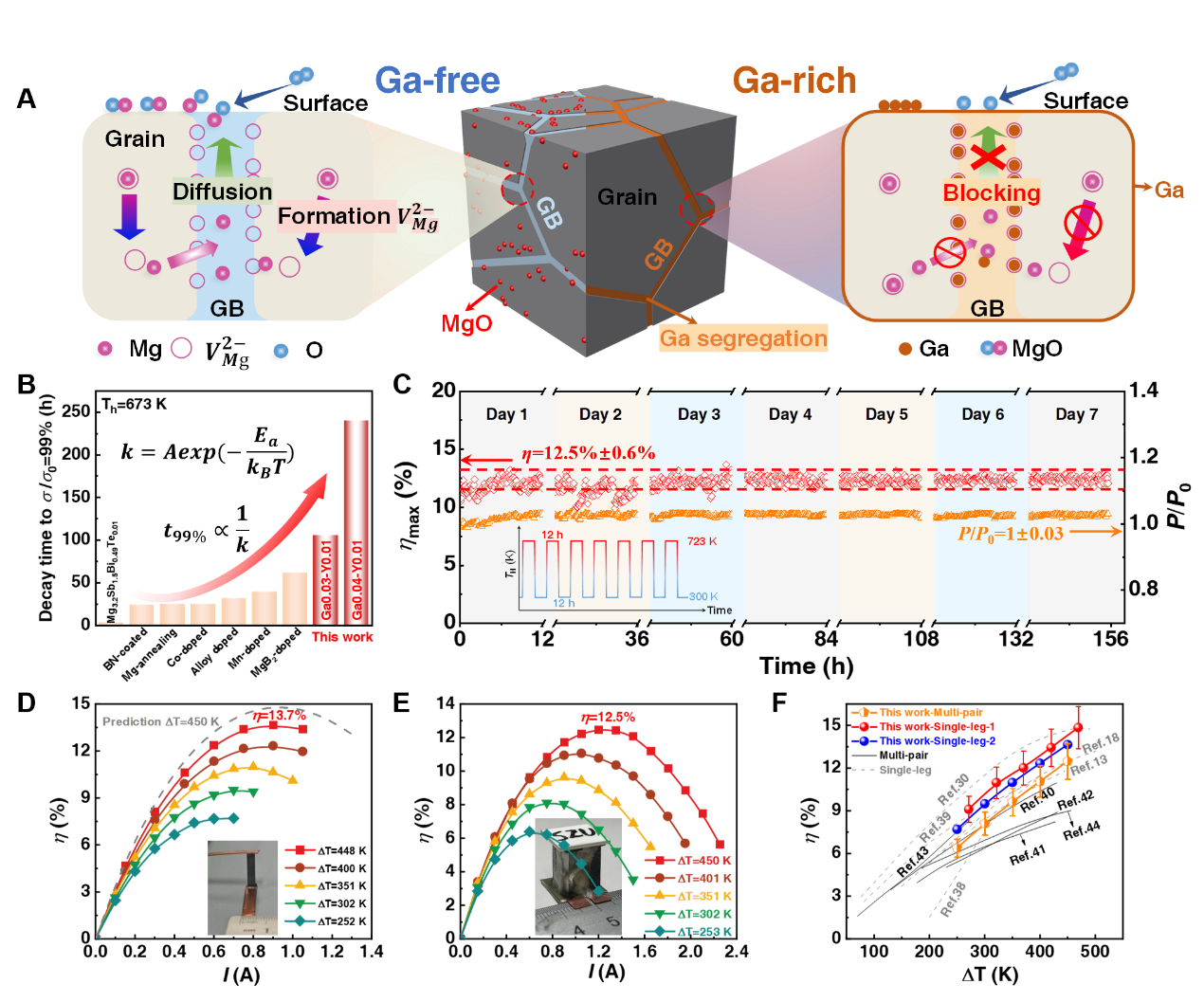
To address this thermal stability issue, the team applied their previously developed grain boundary complexion strategy (Adv. Energy Mater. 2023, 13, 2203361) to the Mg3Sb2-based system. By forming Ga-segregation-induced grain boundary complexions, they significantly enhanced the thermal stability of both Mg3Sb2-based materials and devices. These Ga-segregated grain boundary complexions act as "atomic locks", effectively suppressing the formation of Mg vacancies at grain boundaries, hindering Mg out-diffusion along grain boundaries (which serve as fast diffusion pathways), and preventing reactions with residual gases in the environment. As a result, the thermal stability of Mg3Sb2-based thermoelectric materials is markedly improved. The fabricated single-leg thermoelectric device can maintain an energy conversion efficiency of 12.5% ± 0.6% under a temperature difference of 423 K for 7 consecutive days, demonstrating both high efficiency and excellent durability. This grain boundary engineering approach opens a new pathway for suppressing thermally driven atomic diffusion and reactions, addressing the thermal stability challenges in thermoelectric materials and other Mg-based alloys. To solve the thermal-stability problem of Mg3Sb2-based materials, the team has also developed a melting-sintering method based on a multi-step Mg compensation strategy (Small 2023, 19, 2303840) and a grain boundary method via MgB₂ addition (Small 2024, 20, 2305670).
This work was supported by the Guangdong Basic and Applied Basic Research Foundation. The full text can be accessed at: https://doi.org/10.1016/j.joule.2026.102443