On April 30, 2026, the research team led by Professor Huang Yanfei from the College of Materials Science and Engineering at Shenzhen University, in collaboration with the team led by Professor He Yanbing from Tsinghua Shenzhen International Graduate School, published a study in the Nature Index journal Nature Communications titled "Suppressing concentration polarization in lithium battery composite polymer electrolytes via piezo-assisted electromechanical coupling effect." Dr. Yin Jiayi, a postdoctoral fellow at the College of Materials Science and Engineering, Shenzhen University, is the sole first author. Professors He Yanbing and Huang Yanfei are the corresponding authors, and Shenzhen University is the primary affiliation for this work.
Polymer composite electrolytes (PCEs) incorporating functional fillers have emerged as transformative candidates for high-safety solid-state lithium metal batteries (SSLMBs). However, SSLMBs still suffer from poor cycling stability, especially at high current densities, which is closely related to battery failure caused by lithium dendrite growth. As proposed by the Chazalviel model, when the current density exceeds a critical value, the cation concentration near the anode is continuously depleted and eventually drops to zero after a certain time (defined as the Sand time). This generates a huge space charge and electric field at the electrode, leading to inevitable dendrite growth. Moreover, due to the non‑equilibrium ion distribution and severe concentration polarization, batteries often exhibit other undesirable behaviors, such as low ionic conductivity and a narrow operating voltage window. Therefore, strategically suppressing concentration polarization is a crucial foundation for achieving long‑term cycling stability of SSLMBs at high current densities. According to the definition of the concentration gradient (ΔC ≈ L D₋ /F D₊), rationally increasing the Li⁺ diffusion coefficient (D₊) while limiting the anion diffusion coefficient (D₋) constitutes the fundamental design principle for mitigating the electrolyte concentration gradient and fundamentally suppressing concentration polarization.
In this context, this study prepared a piezoelectric polymer composite electrolyte based on polyvinylidene fluoride (PVDF) blended with 0.5Ba(Zr0.2Ti0.8)O3-0.5(Ba0.7Ca0.3)TiO3(BCTZ). This electrolyte exploits the volume fluctuations of the lithium metal anode during cycling to generate a gradient piezoelectric field, which selectively accelerates Li+ while hindering anion movement, thereby fundamentally suppressing concentration polarization (Figure 1). As a result, the prepared electrolyte exhibits relatively low concentration polarization, achieving a high critical current density of up to 3.7 mA cm-2, stable Li deposition/stripping even at a high current density of 2 mA cm-2, and over 2600 cycles of stability in Li||Ni0.8Co0.1Mn0.1O2 full cells within a potential window of 2.8 to 4.5 V. This study proposes a mechano-electrochemical conversion strategy by constructing a piezoelectric electrolyte to proactively harness the inevitable volume fluctuations of lithium metal to minimize the Li⁺ concentration gradient, providing an effective pathway toward high-performance lithium metal batteries.
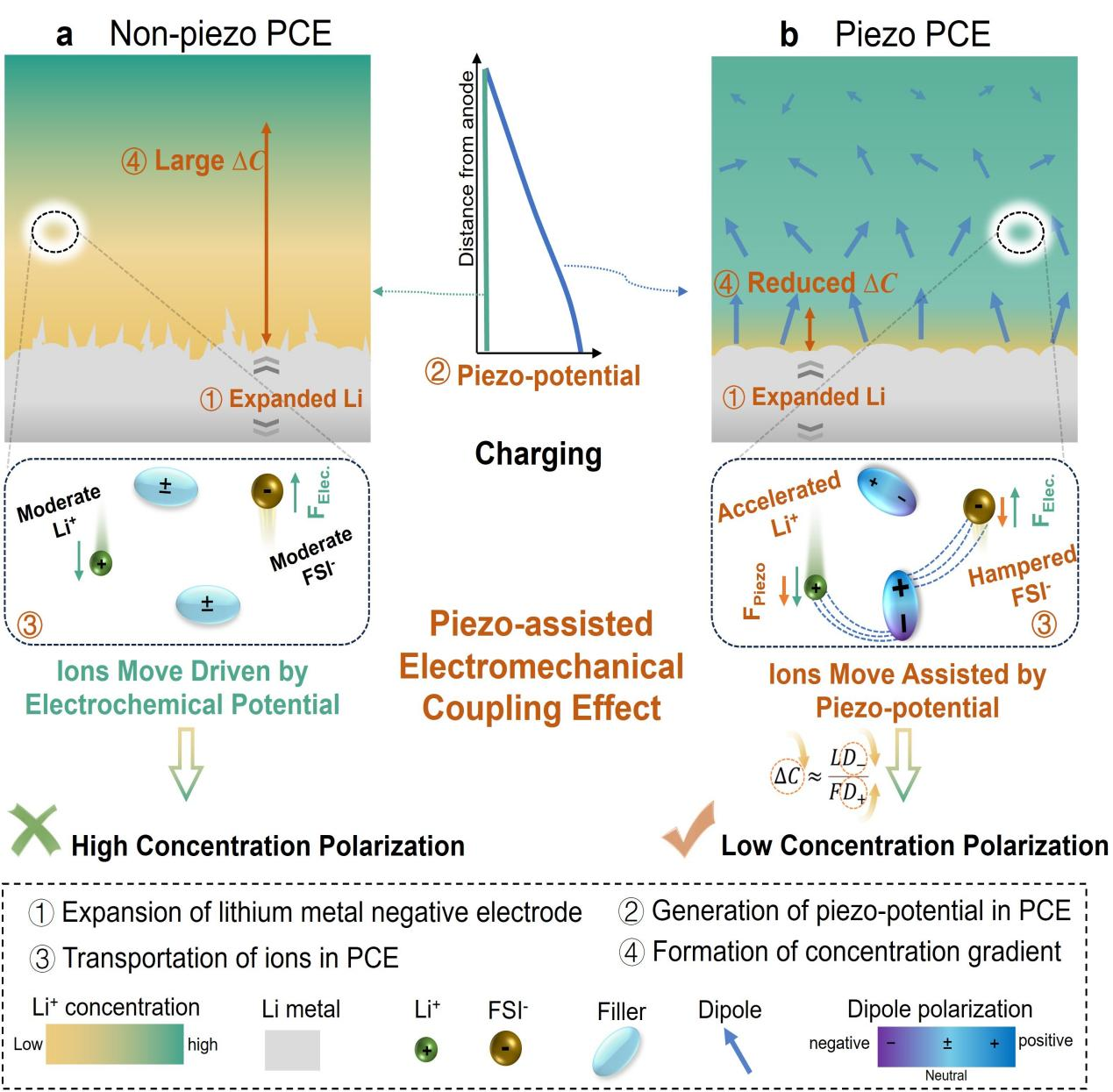
Figure 1 |Schematic illustration of piezo-assisted electromechanical coupling effect.(a)In the non-piezo PCE,the transport of ions is driven by electrochemical potential, leading to a high concentration gradient. (b) In the piezo PCE, the expansion of lithium metal negative electrode during charging leads to spatially heterogeneous piezo-potential gradient in electrolyte, which assists ions transport and results in a low concentration gradient.
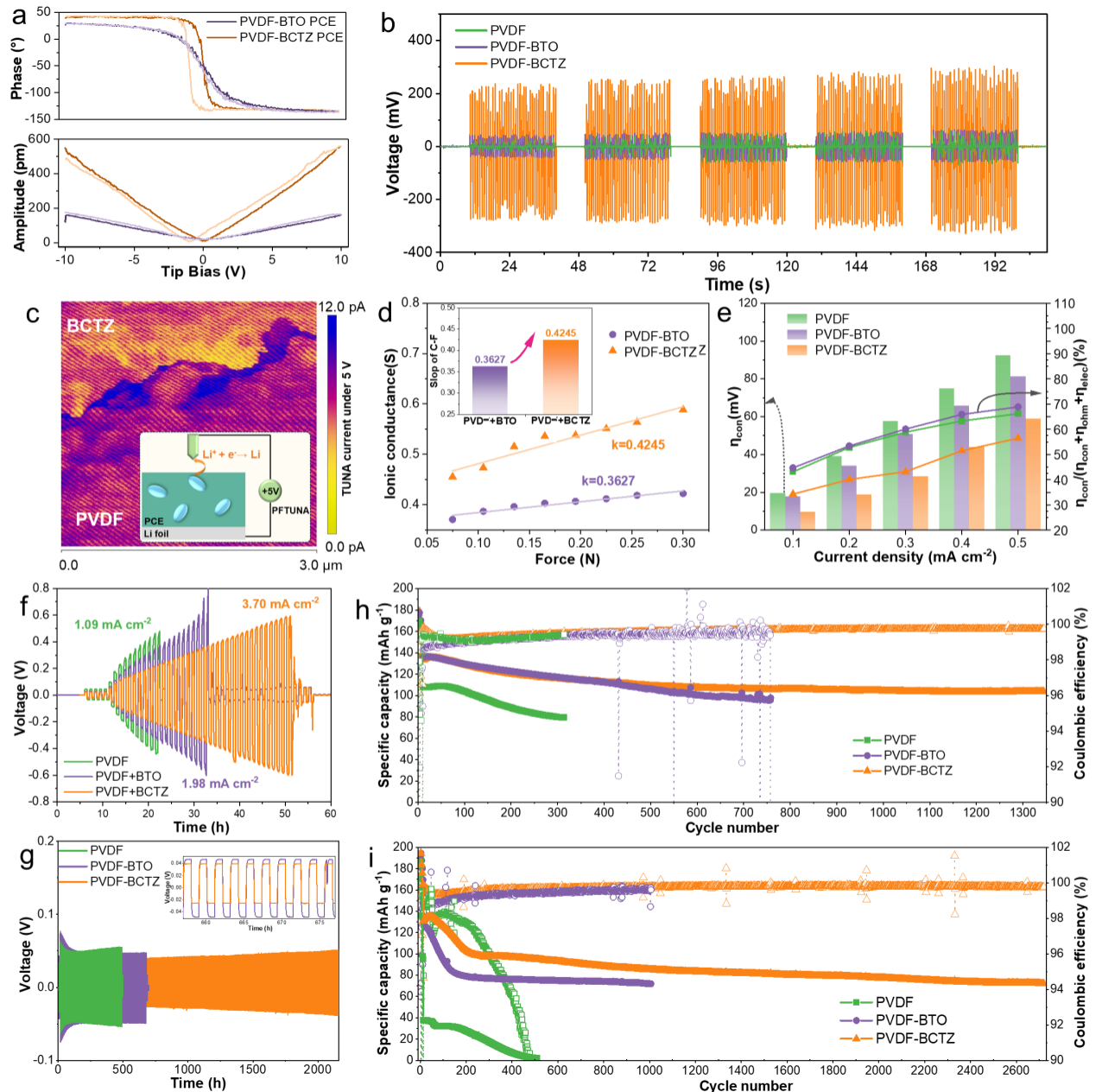
Figure 2 | (a) Phase-voltage and amplitude-voltage curves of PVDF-BTO PCE and PVDF-BCTZ PCE containing lithium salt. (b) Open-circuit voltage over time for pure PVDF film, PVDF-BTO film, and PVDF-BCTZ film (c) TUNA current of PVDF-BCTZ electrolyte under 5 V, the inner figure illustrating the schematic of PFTUNA technique. (d) Ionic conductance under external torsion and their fitting lines, the inner figure presenting slope values of fitting lines. (e) Concentration polarization (ηcon)value (column chart) and its proportion to total polarization (line chart) of assembled symmetric Li||Li cells under varied current density. (f) CCD profiles and values of symmetrical cells with PVDF, PVDF-BTO, and PVDF-BCTZ electrolytes. (g) Galvanostatic cycling curves of symmetric cells at 0.1 mA cm-2 and 0.1 mAh cm-2. (h) Cycling performance of NCM811||PVDF-BCTZ||Li cells at a current density of 360 mA g-1 in the voltage range of 2.8-4.3 V. (i) Cycling stability of NCM811||PVDF-BCTZ||Li cells at a current density of 900 mA g-1 in the voltage range of 2.8-4.5 V.
The authors acknowledge the financial support from the National Natural Science Foundation of China, the Guangdong Basic and Applied Basic Research Foundation, the Shenzhen Science and Technology Research and Development Fund, the Shenzhen All-Solid-State Lithium Battery Electrolyte Engineering Research Center Upgrade Project, the Shenzhen University 2035 Pursuing Excellence Research Plan, and the Yulin Innovation Institute Clean Energy "Energy Revolution" Science and Technology Program.
Original link: https://www.nature.com/articles/s41467-026-72527-0